


Powered By MNT Group
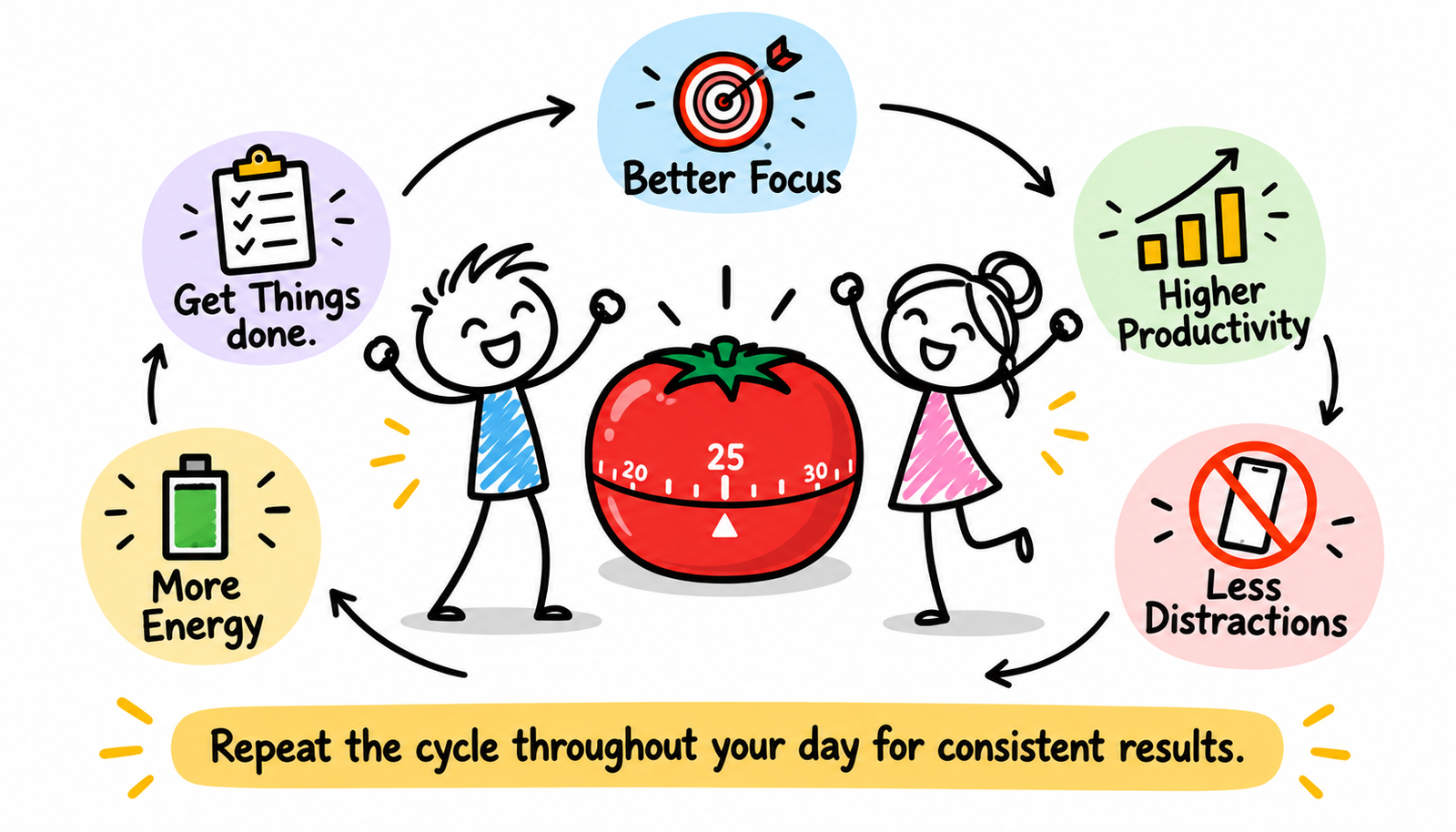
Have you ever sat down to study for two hours, only to realize that you spent half the time checking your phone, switching between tasks, or thinking about what to do next?
The problem may not be that you are lazy or lack discipline. Sometimes, the task simply feels too big, and your brain keeps looking for an easier option.
This is where the Pomodoro Technique can help. Instead of asking yourself to concentrate for hours, you work in short, planned sessions followed by breaks. You can use this method to study for exams, learn English, complete office work, prepare for competitive exams, or manage your daily responsibilities.
But there is more to the Pomodoro method than setting a timer for 25 minutes. The real value lies in deciding what deserves your attention, managing interruptions, and learning how to work without feeling overwhelmed.
In this guide, you will learn what the Pomodoro Technique means, how to use it step by step, how to adapt it to Indian students and working professionals, and when a different approach might work better.
The Pomodoro Technique is a time-management method that divides work into focused sessions separated by planned breaks. It helps you approach a large task in smaller, more manageable parts.
The method was developed by Francesco Cirillo when he was a university student. He used a tomato-shaped kitchen timer to structure his study time. The Italian word pomodoro means tomato.

The basic Pomodoro study technique follows this pattern:
● Choose one task.
● Work on it for 25 minutes without distractions.
● Take a 5-minute break.
● Repeat the cycle.
● After four sessions, take a longer break.
Each 25-minute focused session is commonly called a Pomodoro.
The familiar 25-minute format is a useful starting point, not a rule that everyone must follow. Cirillo's broader method also emphasizes planning, estimating work, recording progress, and managing interruptions.
The Pomodoro method works by giving your work a clear beginning, a defined period of attention, and a planned stopping point.
Instead of thinking, "I have to study the entire chapter today," you might think, "For the next 25 minutes, I will understand and summarize these three pages."
That small change makes it easier to get started and gives you a specific target.
Here is an example of a study session using the traditional format.
| Time | Activity |
|---|---|
| 9:00–9:25 AM | Study one topic |
| 9:25–9:30 AM | Take a short break |
| 9:30–9:55 AM | Practise questions |
| 9:55–10:00 AM | Take a short break |
| 10:00–10:25 AM | Revise difficult concepts |
| 10:25–10:30 AM | Take a short break |
| 10:30–10:55 AM | Test your understanding |
| 10:55–11:10 AM | Take a longer break |
This schedule gives you 100 minutes of planned study time, including 15 minutes of longer rest after four sessions.
The goal is not to collect as many Pomodoros as possible. It is to make meaningful progress on the work that matters.
You do not need special equipment, an expensive subscription, or a complicated productivity system. A clock, a task list, and a little consistency are enough to begin.
Decide exactly what you want to finish. "Study English" is too broad. "Listen to one English lesson and write down ten useful sentences" is much clearer.
Start with 25 minutes. Keep your phone away, close unrelated browser tabs, and open only what you need for the task.
Stay with the chosen activity as much as possible. If another task comes to mind, write it down and return to your current work instead of immediately switching.
Stop working for about five minutes. Stand up, stretch, drink water, or look away from the screen. Give your mind a chance to recover.
Begin the next session with a clear task. After four sessions, consider a longer break of around 15–30 minutes. Review what you completed and decide what needs attention next.
Distractions happen. A single interruption does not mean you have failed.
Try this simple process:
1. Notice the distraction without getting annoyed with yourself.
2. Write down the unrelated thought or task.
3. Return to your original task.
4. If an urgent interruption requires your attention, pause and handle it appropriately.
For example, if you suddenly remember that you need to pay a bill, add it to your task list instead of opening your banking app immediately.
For interruptions that cannot wait, stop the session and restart when you are ready. The purpose is to improve your attention, not to obey a timer at all costs.
The technique can be useful whenever a task benefits from sustained attention and can reasonably be divided into smaller periods.
| Use case | Example of a focused session |
|---|---|
| School and college studies | Understand one concept and answer practice questions |
| Competitive exam preparation | Solve a set of quantitative aptitude problems |
| Spoken English | Listen to a lesson and practise speaking aloud |
| Reading | Read a section and note its key ideas |
| Office work | Prepare a report or review a specific set of documents |
| Writing | Draft one section of an article |
| Online learning | Watch a lesson and complete its exercise |
| Household tasks | Organize one cupboard or clean one defined area |
For students in India preparing for board exams, college examinations, NEET, JEE, UPSC, or other competitive exams, the technique can help turn a long syllabus into manageable tasks.
Suppose you have three hours available for studying physics. Rather than writing "Physics" on your timetable, break the work into focused goals:
● Session 1: Understand one concept.
● Session 2: Work through solved examples.
● Session 3: Solve practice questions.
● Session 4: Check mistakes and revise difficult points.
You can repeat the process for another subject after a longer break.
One important detail: finishing a timed session does not mean you have mastered the topic. Use practice questions, active recall, and revision to check whether you actually understand what you studied.
If you are learning spoken English, you can use a session to practise one skill instead of trying to improve everything at once.
For example, a 25-minute session might include:
● 5 minutes of listening to a short conversation.
● 10 minutes of repeating sentences aloud using shadowing.
● 5 minutes of speaking without reading the script.
● 5 minutes of reviewing mistakes and unfamiliar expressions.
This is only one possible session structure. You can adjust the time to match your level and learning goal.
The key is to decide what you will practise before starting the timer.
The Pomodoro Technique offers several practical benefits, although the results depend on the task, your working habits, and how consistently you use it.
Large tasks can feel intimidating. A 25-minute commitment often feels more manageable than an open-ended demand to work for several hours.
You do not need to feel fully motivated before beginning. You only need to start the next session.
A simple record of completed sessions can reveal how long particular tasks take.
If preparing one report regularly takes six sessions rather than the three you expected, you can plan more realistically next time.
Writing down unrelated thoughts helps you avoid switching tasks every time something comes to mind.
Over time, you may also begin to recognize your common distractions, such as notifications, unnecessary browsing, or repeatedly checking messages.
A planned work-and-break cycle creates a repeatable structure. This can be particularly useful if you struggle to begin studying or working at a consistent time.
Short breaks interrupt long periods of continuous work. A 2022 systematic review and meta-analysis covering 22 study samples and 2,335 participants found that micro-breaks had small benefits for vigor and fatigue, but did not significantly improve overall performance across the studies. The results varied by task.
That distinction matters: breaks can help you feel less tired without automatically making every task faster or more accurate.
Recording what you completed, what interrupted you, and what remains unfinished can help you make better decisions about future sessions.
This reflective element is also consistent with the broader Pomodoro method, which goes beyond simply using a timer.
It can be effective for managing distractions, structuring work, and making large tasks feel manageable, but it is not equally effective for everyone or every task.
The distinction between usefulness and guaranteed performance improvement is important.
The research on short breaks provides some support for improved well-being and reduced fatigue, but the 2022 meta-analysis did not find a statistically significant improvement in overall performance. Its findings also suggest that the effects depend on the type of task.
The Pomodoro Technique itself is a broader time-management approach, so evidence about short breaks should not be treated as proof that the entire method will improve everyone's productivity.
It is worth trying if you:
● Procrastinate because a task seems too large.
● Frequently check your phone while studying.
● Have difficulty starting work.
● Need structure for independent study.
● Want a practical way to estimate how long tasks take.
It may be less suitable when:
● You are deeply absorbed in a task and stopping would interrupt your thinking.
● Your work involves frequent urgent interruptions.
● You need a long, uninterrupted period for complex reasoning.
● Your task is too unpredictable to divide into fixed intervals.
● You spend more time managing the timer than doing useful work.
In these situations, try longer focus sessions, flexible breaks, or a task-based schedule instead.
A break should help you step away from the task, not become another activity that consumes your attention.
The original creator's perspective is especially interesting here: he has cautioned against reducing the whole method to a timer and has discussed breaks as a chance to stop rather than immediately fill every moment with another activity.

Good break activities:
● Stretch or walk around.
● Drink water.
● Rest your eyes.
● Breathe quietly.
● Sit without doing anything.
Activities to limit:
● Scrolling social media.
● Watching short videos.
● Opening unrelated websites.
● Starting a demanding new task.
● Checking notifications repeatedly.
Using your phone is not automatically wrong, but it can make a five-minute break harder to keep short. Choose an activity that leaves you ready to return to work.
Do not invent extra work simply to fill the remaining minutes.
Check your work, review the key points, or use the remaining time for a closely related activity. If the task is genuinely complete, record that and decide what to do next.
Likewise, if the timer rings while you are in the middle of a difficult problem, you can make a note of where you stopped and take your break. If stopping at that moment would seriously disrupt your concentration, finish the immediate thought and adjust the session. The aim is a sustainable routine, not mechanical obedience.
Many people try the method for a day or two and abandon it because they make the process unnecessarily rigid.
Avoid these common mistakes:
| Mistake | A better approach |
|---|---|
| Choosing a vague goal | Define one task you can make progress on |
| Checking your phone during a session | Silence notifications and move your phone away |
| Using breaks for endless scrolling | Choose a low-distraction activity |
| Treating every interruption as failure | Record distractions and resume when possible |
| Forcing every task into 25 minutes | Adjust session length to the task |
| Counting sessions instead of results | Measure completed work and understanding |
| Skipping breaks to finish faster | Allow time to recover when needed |
| Expecting instant productivity | Test the method over several days |
One particularly common mistake is assuming that more Pomodoros automatically mean more productivity. Four focused sessions that help you understand a difficult concept can be more valuable than eight sessions spent switching between unrelated tasks.
The best session length is the one that gives you enough time to make meaningful progress without making it unnecessarily difficult to stay focused.
The traditional starting point is 25 minutes of work followed by a 5-minute break. However, you can experiment with other intervals.
| Format | Work | Short break | Suitable for |
|---|---|---|---|
| Short focus | 15 minutes | 5 minutes | Beginners or tasks that feel difficult to start |
| Classic Pomodoro | 25 minutes | 5 minutes | General study and office tasks |
| Extended focus | 45 minutes | 10 minutes | Tasks that require more sustained attention |
| Deep work | 50 minutes | 10 minutes | Longer reading, writing, or problem-solving sessions |
These alternatives are practical starting points, not scientifically established universal optimums.
For a long study session, you can take a longer break after a few work periods. You should also feel free to stop earlier if you become unwell, excessively tired, or unable to concentrate effectively.
Start with the classic 25/5 format for three to five days. After each session, note whether you completed your task and whether the interval felt comfortable.
If 25 minutes feels too long, try 15 minutes. If you regularly reach a productive rhythm after 25 minutes, experiment with 35 or 45 minutes.
The point is to find a useful balance between concentration and recovery.
The Pomodoro Technique is not the only way to manage time. Different methods solve different problems, and you can combine them when it makes sense.
| Method | Main idea | Best use |
|---|---|---|
| Pomodoro Technique | Alternate focused work and breaks | Managing distractions and getting started |
| Time blocking | Assign activities to calendar periods | Organizing a full day |
| Eisenhower Matrix | Prioritize by urgency and importance | Deciding what to do first |
| Getting Things Done (GTD) | Capture, organize, and review commitments | Managing many tasks and projects |
| Deep work | Protect periods of intense, distraction-free concentration | Complex or demanding work |
For example, you could use the Eisenhower Matrix to decide which assignment matters most, time blocking to schedule it for the morning, and the Pomodoro Technique to work on it.
These approaches are complementary rather than mutually exclusive.
You do not need an app to use the Pomodoro method. A basic clock or kitchen timer is enough.
However, a Pomodoro technique app can be useful if you want session history, reminders, task lists, or a record of your study habits.
Here are several tools worth considering. Their current features, free limits, and pricing can change, so check the official websites before choosing a plan.
Pomofocus
A browser-based timer to consider if you want to start a focus session without installing a dedicated desktop application.
Website: pomofocus.io
Forest
Worth exploring if a visual reward helps you stay away from your phone while focusing.
Website: forestapp.cc
Focus To-Do
A candidate for people who prefer to combine task lists and timed focus sessions in one place.
Website: focustodo.cn
Look for a tool that matches your needs rather than one with the most features.
Consider these questions:
● Can you set a custom work and break duration?
● Can you use it without paying?
● Does it work on your phone or computer?
● Can you track tasks or completed sessions?
● Does it create fewer distractions than it removes?
For many students, the simplest timer is the best choice. You do not need to spend 20 minutes customizing a productivity app before beginning a 25-minute study session.
Not necessarily. The number of hours spent studying does not tell you how much you have learned.
A student who studies for two hours using focused practice and regular review may achieve more than someone who spends four hours rereading notes while frequently checking messages. However, the outcome depends on the subject, the learner, and the quality of the study methods.
The Pomodoro Technique helps structure study time; it does not replace effective learning techniques.
For stronger study sessions, combine it with:
● Active recall: Try to remember information without looking at your notes.
● Practice questions: Apply what you have learned.
● Spaced repetition: Review material at intervals rather than only once.
● Self-explanation: Explain a concept in your own words.
● Progress reviews: Identify what you understand and what still needs work.
For example, a 25-minute biology session could involve studying a topic for 10 minutes, recalling the main ideas for 10 minutes, and checking mistakes for the remaining five minutes.
This gives the session a clear learning objective instead of merely filling time.
You do not need to use Pomodoro for every activity in your day. Start with one or two tasks where better focus would make a noticeable difference.
Here is a sample routine for a student or working professional in India. Adjust the times to suit your classes, work schedule, commute, and personal responsibilities.
| Time | Activity |
|---|---|
| 7:30–7:55 AM | Study or complete a priority task |
| 7:55–8:00 AM | Short break |
| 8:00–8:25 AM | Practise questions or review work |
| 8:25–8:30 AM | Short break |
| 8:30–8:55 AM | Complete another focused task |
| 8:55–9:00 AM | Short break |
| 9:00–9:25 AM | Review and correct mistakes |
| 9:25 AM onward | Longer break and continue your normal routine |
The schedule is only an example. If your mornings are busy, move the sessions to the afternoon or evening.
Keep your tracking system simple. At the end of each day, record:
● How many sessions you completed.
● Which important tasks you finished.
● What distracted you.
● Whether your chosen session length worked.
● What you want to accomplish tomorrow.
After a week, look for patterns. You may discover that you concentrate better in the morning, that certain tasks need longer sessions, or that your phone is your biggest source of interruption.
Use those observations to improve your routine instead of judging yourself by a daily score.
The Pomodoro Technique is a practical way to organize your time, reduce distractions, and make difficult tasks easier to begin. Its familiar 25-minute work session and 5-minute break provide a simple starting point, but the method works best when you adapt it to your needs.
Choose one clear task, work with as few interruptions as possible, take your breaks, and review what you accomplish. If 25 minutes feels too long or too short, experiment with a different interval.
Remember, the purpose of time management is not to keep yourself busy every minute. It is to use your attention wisely and make steady progress on the things that matter.
Start with one Pomodoro today. You can improve your routine as you learn what works for you.
● Official Pomodoro Technique site: https://www.pomodorotechnique.com
● Ariga, A. and Lleras, A. (2011). Brief and rare mental “breaks” keep you focused. Cognition.
● Albulescu, P. et al. (2022). “Give me a break!” A systematic review and meta-analysis on the efficacy of micro-breaks for increasing well-being and performance. PLOS ONE.
● Parkinson, C. N. (1955). Parkinson’s Law. The Economist.
● Cirillo, F. The Pomodoro Technique.
Pomodoro is the Italian word for tomato. The method gets its name from the tomato-shaped kitchen timer that Francesco Cirillo used while developing the technique as a student. Today, a Pomodoro commonly refers to one focused work session.
Yes. You can use a regular clock, a kitchen timer, or a timer on your phone. An app is optional; what matters is choosing a task, setting a reasonable work period, minimizing distractions, and taking breaks.
There is no universal daily target. Choose a number that fits your workload, energy, and responsibilities. Focus on completing meaningful work rather than trying to achieve an arbitrary session count.
Yes, if music helps you concentrate rather than distracting you. Instrumental music or familiar background sounds may suit some people, while others work better in silence. Try both and compare the quality of your work.
Do not force yourself to continue simply because the timer is running. If you are sleepy, take an appropriate break, move around, or rest if needed. A timer cannot replace adequate sleep or recovery.
It can help by reducing the size of the commitment required to begin. Instead of promising to finish an entire project, commit to working on the first small part for 15 or 25 minutes. If procrastination remains a persistent problem, you may need to address the reasons behind it as well.
Yes. You can use it to organize independent study before or after an online class, complete exercises, or review notes. During a live class, however, follow the lesson and your instructor's schedule rather than interrupting the class every 25 minutes.
Break the task into smaller steps and continue in another session. For example, writing an article might require separate sessions for outlining, researching, drafting, and editing. Record your progress so you can resume without starting over.
Yes. Time blocking helps you decide when to work on a task, while the Pomodoro Technique structures the work itself. You might reserve 9:00–10:30 AM for exam preparation and use several focused sessions within that period.
The term is sometimes used informally to describe the improvement in perceived focus or task management that people experience when they divide work into timed sessions. It is not a single, universally defined scientific effect, and using the technique does not guarantee improved performance.
The five steps are simple: choose a task, set a timer for 25 minutes, work without distractions, take a 5-minute break, and repeat. After completing four sessions, take a longer break of 15–30 minutes.
Both methods can be effective. The 25/5 method is ideal for beginners and people who get distracted easily. The 50/10 method works well for people who can concentrate for longer periods. Try both to see which suits you best.
Yes, the Pomodoro Technique can make studying more organized and manageable. It helps reduce distractions, encourages regular breaks, and makes it easier to start difficult tasks. For better results, combine it with active recall, practice questions, and regular revision.
Francesco Cirillo developed the technique through personal experimentation as a student. He found that 25-minute work sessions were a useful way to manage time and maintain focus. However, 25 minutes is not a strict rule; you can adjust the duration to suit your needs.
The method was created by Francesco Cirillo, who used a tomato-shaped kitchen timer while studying. Since pomodoro means “tomato” in Italian, he named the method the Pomodoro Technique.
There is no reliable, publicly verified evidence confirming that Elon Musk specifically uses the Pomodoro Technique. Although he is known for his time-management practices, it is better not to claim that he uses this method without a trustworthy source.

Powered By MNT Group